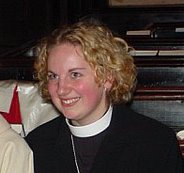
Delivered by The Rev. Mary Cat Young
November 8, 2009
The Episcopal Church of Our Saviour
Ruth 3:1-5; 4:13-17
Psalm 127
Hebrews 9:24-28
Mark 12:38-44
Before I begin, let me share with you a quick story about how this little item came into my possession. During my seminary days I lived right next to Harvard Square in Cambridge, Massachusetts. One night, while on a walk with a friend we were standing on a street corner talking about NPR’s show Car Talk (Cah Tawlk). A man overheard us and mentioned that the studio they broadcast from was across the hall from his business, along with the law offices of “Dewey, Cheatem and Howe.” My companion and I laughed and accepted his invitation to come up and see the doors to the studio.
As we walked up the stairs he asked us about ourselves. When he heard that I was a seminarian he said, “I’d like to give you something.” The man shared with us that he was Jewish and his business was dealing in rare coins and collectibles. He gave me this little square coin holder which holds a “Widow’s Mite,” a small copper coin dated from the time of Herodias Antipas, and thus the kind of coin like the one’s spoken of in our Gospel story this morning. He wanted me to have it, and though I tried to refuse, his gift of kindness to me was of greater value him than the coin itself. It was a friendly gesture – and one that cost him very little, but showed his genuine desire for the coin to serve a purpose of goodness in my future work. And that is how this widow’s mite came into my possession.
To see it, is to see what nothing looks like. The insignificance of a coin such as the one the widow gave is obvious when you have it in your hand. Less than a penny was the value, and yet to a woman of her time and place, a woman who had no regular means of income, no one’s protection, no one to fend for her in the world, this little nothing was literally everything.
The faith she invested in this coin, and the way that she used it is commendable. She knew that giving to the temple was a means of participating in the relationship she had with God – participating in the ritual, not only with her prayers, but with what little she had in her pockets.
The tragedy here is that as Jesus watched her do this, he lamented that her giving was to a corrupt house that would not return the care to her that she so desperately needed. He saw the giving of her heart, and yet wept at the injustice that she would not properly be cared for in the way she deserved. Jesus pointed to a flawed system that allowed its most vulnerable member give all that she had in the name of God. He knew that she would not reap the benefits of the care that she deserved after literally giving her life away with a contribution that was worth practically nothing. But it was hers to give, and she gave it willingly.
The converse image is shown to us as well; that of the boasting, flashy, prideful giver – a leader in the synagogue, well dressed, well statured, and making it well known that their giving was worthy of notice. And yet, despite the monetary value of the giving of the rich, that which is given out of arrogance is less valuable than the gift of the widow’s mite.
When considering what we have to offer, what we can afford to give, and who we should share our resources and financial gifts with, the question: “How much is enough?” is often posed. We live in tough economic times. Pensions that were invested in the stock-market have been reduced. Job security is questionable on a day-to-day basis in some fields. College educations are to be funded, mortgage payments to be kept up, and health expenses to be paid or prepared for. Everyone is at risk. Everyone is vulnerable. And despite the fine clothing, and the privilege of climate-controlled home environments, we all feel as though we have more in common with the widow than the scribe described in the story. “Enough” is a question that comes out of a place of scarcity, a place of fear. What is the acceptable offering? What can I do to fulfill my obligation and be done with it?
“Enough” does not encompass the abundant gift of giving with love. Truly, the greatest difference between the widow and scribe is the fact that what she gave was not only a monetary gift, but one of faith, a gift of the heart. Her own well-being, her own necessity for simple things were not at stake – because for her, she was giving her love.
The same was true of the man who gave me the gift of the widow’s mite. Surely some monetary value is attached to this tiny little piece of nothing, certainly more now than when it was currency in its own time and place. But the value of sharing a conversation with others on a lonely night, the value of knowing that this would be put to use by someone to whom it did matter, the value of doing a Mitzvah, or a simple act of human kindness was worth more to this man in the simple act of giving it away than any cash value he might receive upon achieving a bill of sale.
As you open yourself to the season of discernment that is inevitable at this time in the church year – the time of contemplating how your gifts, how your time, how your talent might be given to participate in the needs of others, the needs of this community and the needs of the world, I remind you of the importance of allowing your heart to enter the process. What and how you give of yourself does not rely on the question of “how much is enough.” Because when your heart is in it, the abundance and generosity of the spirit within you allows you to do amazing things.
Certainly there are the real life, hard numbers that need to happen in terms of the upkeep and maintenance of the building where we gather – but our life together, our community of care for one another, the sense of commitment to one another that makes us want to give a helping hand in the garden, to volunteer with the youth activities, to host a family of promise dinner, to be in conversation through Sunday school classes, and to face the needs of the poor who are not only just outside our doors, but in our Garth, and in our parish hall, and in the presence of our community, these are the ways that this building calls our hearts and hands and our financial resources in to action – into the business of building the kingdom of God right here, and right now. These things are priceless.
Just as Christ’s giving of himself for us, even to the point of death on the cross… his gift for the world was of a value that meant nothing to him – he was God – he could die a thousand times and it would not mean anything because of the power he possessed to overcome death. And yet, the gift that it was for us, the gift of the promise of eternal life, the gift of redemption from our sins, that no matter who we are or how we struggle with this life, there is a love and forgiveness and resurrection that belongs to us through Jesus Christ, that gift to us is priceless. How much is enough? Is this the community where you choose to invest yourself, where you invest your children and families, where you give your heart away to those who, without you would not be cared for? If you give your whole heart, then you’ve just begun. For “where your heart is, there will your treasure be also.” (Matthew 6:21 author paraphrase) Amen.
Tuesday, November 10, 2009


Proper 23, Year B, RCL
Amos 5:6-7, 10-15
Psalm 90:12-17
Hebrews 4:12-16
Mark 10:17-31
The Bible is a funny thing. Though we receive it in our contemporary context as one volume that can easily be accessed, carried around, handled like any other book, we often overlook the fact that rather than it being one book, it is a library of texts. A collection of over 70 history books, letters, gospels, wisdom sayings, songs, poems, law references and stories written by as many or more authors, not to mention editors, redactors, translators, and the number of hands that adjusted, corrected and enhanced the words delivered to us, collected and formatted into one cozy little volume.
In other words, the writings that we listen to, the words we remind ourselves of, the saying and stories that we hear when we gather as a community to learn together, have come a long way to get into our hands, and to be heard by our ears.
William Tyndale, a determined protestant reformer and minister of the 16th Century made it the focus of his life to ensure that English speaking Christians gained access to the privilege of hearing scripture spoken in their language. His work to directly translate the Old and New Testaments from their Hebrew and Greek written forms were directly opposed by authorities of Roman Catholicism and the Royal Court. His commitment to this cause allowed him to be responsible for writing almost 90% of the King James Version of the Bible. Tyndale is attributed with coining the phrases: “let there be light,” “my brother’s keeper,” “salt of the earth,” and “fight the good fight” to name a few. This week we remembered William Tyndale on October 6, the anniversary of his death nearly 500 years ago.
There is no record of why Tyndale was so committed to translating scripture – but it is clear from his life’s story that he would not rest, and did not allow the danger of this business to keep him from accomplishing this task, even though it cost him his life. Perhaps he was a poetic writer and enjoyed the challenge. Perhaps he was a lover of the church and of the Word, and recognized the challenge and the promise that lay within the texts he devoted his life to. Perhaps he simply believed that the message found in scripture again and again that the law of love is truly the greatest commandment should be spoken to men and women on the street in their own language, so that those who needed to hear that message most could do so and understand immediately.
Regardless of his motivations, William Tyndale’s work grants us access to the wisdom and the challenge that lies in our scripture readings each week. And it is our duty as faithful bearers of this library to take on the challenging task of wrestling with scripture – in our own lives and in our life as a community.
In seminary I had the opportunity to take a scripture course titled: Texts of Terror, named for a book of the same title that explores some of the hardest passages of the Bible. Stories of misogyny, of unjustifiable violence, of wrathful vengeance, and of Biblical teachings that may be difficult to consider, all that exist within the canon of the texts we hold sacred. So sacred in fact, that at the ordination of deacons, priests and the consecration of bishops, ordinands not only vow to devote themselves to the study of scripture, but also sign a commitment that states that we believe all things necessary for salvation are contained in holy scripture. When it came time for me to preach in that class, today’s Gospel was my chosen “text of terror.”
As a person who has benefitted from privileges being a middle class Caucasian raised in the Western world, I have had good reason to fear and disparage at the hearing of this text. After all, like the rich man, I have followed the commandments, I have committed myself to a faith life and practice that is devoted to proclaiming Jesus as my savior, and I too, have many possessions. Isn’t my faith enough? Isn’t my desire to follow enough? Isn’t it my right that I should enjoy the earnings that I have worked hard for, that I have given time and talent to produce, and thus collect my rightful compensation, and enjoy life in the here and now? Does the question sound familiar?
And yet here we have a Gospel text that says, not so fast.
You may lead a life that is good and righteous. You may not waste your sins on murder and slander. But if your own piety is solely devoted to the perfection of your own soul, if your desire to fulfill your own need to be faultless allows you ignore the obvious needs of those around you, then you have missed the point completely.
The rich man seeks to possess something he cannot buy – eternal life. Jesus looks with compassion upon the rich man. But he also speaks a hard truth to him. Those commandments that you live by, you do with ease. For you are in a position that allows you rise above those challenges. Your wealth allows a freedom and a privilege in the way you live your life that is only known to a small fraction of the community in which you live. And yet, that wealth is not a means of grace. It is not a means of receiving the immeasurable gift of the assurance of God’s love for you for all time. In fact, if that material wealth is what provides your only sense of self-value and your only means of judging your position in the world, then it will actually hinder you from the ability to receive the grace of God. If you wish to follow me, if you wish to uphold my teaching, then you should not allow yourself to be bound by your belongings. To be possessed by your possessions. Let them go, and let yourself understand what it is to live like those who live only by the grace of God and by the kindness of their community. When you are ready to do this, you will be in a position to understand and receive eternal life.
The rich man was discouraged by this, and rightfully so. After all, sacrifice is not about giving offerings that mean nothing to you. There is no challenge in that. The challenge for the wealthy is the opportunity to let go of some privilege, some of the freedom that wealth provides, so that others might benefit from it – those who would have no way of experiencing certain freedoms, like the living without fear of the next medical bill that will arrive in the mail, or the inability to cover the cost to educate your child so that they might have opportunities that you did not. I wonder if the rich young man was being challenged to experience the world in a new way, so that he might gain a deeper understanding of the capacity of kindness he could offer his community as a result of his position of wealth.
I wonder if he didn’t leave Jesus’ side and consider how he might change the way he used his riches in the world around him. I wonder if he allowed Jesus’ words to enter in – or if it was similar to the difficulty of allowing a camel through the eye of a needle.
It’s a funny thing scripture, there is not just one mention of a rich young man. There are other stories in the old and new testament of rich men using their wealth unjustly – to seek power over others, to allow their privilege to supersede that of poor men under their care – to take unfair advantage of the position of power that their wealth granted them in the here and now. And there are wisdom sayings and psalms, warning the rich man to make right choices with their treasure, for despite their power and privilege today, they will perish and those riches will not travel with them. This is not a new message, but it is a challenge that scripture poses to us today.
In our contemporary context, most of us live in relative comfort, some more than others, but generally speaking, we live with the security of income, comfortable housing, and access to discretionary spending – that is, income that does not go to providing food, shelter and basic necessities. How we, as wielders of discretionary spending choose to use our wealth – where we choose to live and the lifestyle we choose to pursue all play into this challenge posed by Jesus.
How will you allow these words of scripture, this challenging story of Jesus and the rich young man to enter in as you consider the wealth, and its power and privilege that is at your fingertips? Does this story pose itself as a text of terror for you? Do you find yourself wondering how a camel makes its way through the eye of a needle?
As we give thanks for the access that we have for scripture in our lives, we must also take up the challenges it poses. We must also accept the responsibility that we have received as hearers of the word – as ones who wish to follow, but must do so with the burden of wealth and privilege that our contemporary society provides.
When last I preached on this text I was weighed down by many possessions. Things that surrounded me, but had little purpose, nor provided insight into the life I was being called to lead. Many things have changed for me, and though many of those possessions are gone, there are new ones that have found their way into my life and my home. With each return to this piece of scripture I must take up for myself the question that Jesus has for the rich young man. Upon hearing it today, I am reminded that Jesus loved the man, and then challenged him again. I call on you to know that Jesus loves you, and challenges you to consider these things today as well.
For Jesus said,
"Truly I tell you, there is no one who has left house or brothers or sisters or mother or father or children or fields, for my sake and for the sake of the good news, who will not receive a hundredfold now in this age--houses, brothers and sisters, mothers and children, and fields with persecutions--and in the age to come eternal life…” Amen.
Delivered by The Rev. Mary Catherine Young
October 11, 2009
The Episcopal Church of Our Saviour
Psalm 90:12-17
Hebrews 4:12-16
Mark 10:17-31
The Bible is a funny thing. Though we receive it in our contemporary context as one volume that can easily be accessed, carried around, handled like any other book, we often overlook the fact that rather than it being one book, it is a library of texts. A collection of over 70 history books, letters, gospels, wisdom sayings, songs, poems, law references and stories written by as many or more authors, not to mention editors, redactors, translators, and the number of hands that adjusted, corrected and enhanced the words delivered to us, collected and formatted into one cozy little volume.
In other words, the writings that we listen to, the words we remind ourselves of, the saying and stories that we hear when we gather as a community to learn together, have come a long way to get into our hands, and to be heard by our ears.
William Tyndale, a determined protestant reformer and minister of the 16th Century made it the focus of his life to ensure that English speaking Christians gained access to the privilege of hearing scripture spoken in their language. His work to directly translate the Old and New Testaments from their Hebrew and Greek written forms were directly opposed by authorities of Roman Catholicism and the Royal Court. His commitment to this cause allowed him to be responsible for writing almost 90% of the King James Version of the Bible. Tyndale is attributed with coining the phrases: “let there be light,” “my brother’s keeper,” “salt of the earth,” and “fight the good fight” to name a few. This week we remembered William Tyndale on October 6, the anniversary of his death nearly 500 years ago.
There is no record of why Tyndale was so committed to translating scripture – but it is clear from his life’s story that he would not rest, and did not allow the danger of this business to keep him from accomplishing this task, even though it cost him his life. Perhaps he was a poetic writer and enjoyed the challenge. Perhaps he was a lover of the church and of the Word, and recognized the challenge and the promise that lay within the texts he devoted his life to. Perhaps he simply believed that the message found in scripture again and again that the law of love is truly the greatest commandment should be spoken to men and women on the street in their own language, so that those who needed to hear that message most could do so and understand immediately.
Regardless of his motivations, William Tyndale’s work grants us access to the wisdom and the challenge that lies in our scripture readings each week. And it is our duty as faithful bearers of this library to take on the challenging task of wrestling with scripture – in our own lives and in our life as a community.
In seminary I had the opportunity to take a scripture course titled: Texts of Terror, named for a book of the same title that explores some of the hardest passages of the Bible. Stories of misogyny, of unjustifiable violence, of wrathful vengeance, and of Biblical teachings that may be difficult to consider, all that exist within the canon of the texts we hold sacred. So sacred in fact, that at the ordination of deacons, priests and the consecration of bishops, ordinands not only vow to devote themselves to the study of scripture, but also sign a commitment that states that we believe all things necessary for salvation are contained in holy scripture. When it came time for me to preach in that class, today’s Gospel was my chosen “text of terror.”
As a person who has benefitted from privileges being a middle class Caucasian raised in the Western world, I have had good reason to fear and disparage at the hearing of this text. After all, like the rich man, I have followed the commandments, I have committed myself to a faith life and practice that is devoted to proclaiming Jesus as my savior, and I too, have many possessions. Isn’t my faith enough? Isn’t my desire to follow enough? Isn’t it my right that I should enjoy the earnings that I have worked hard for, that I have given time and talent to produce, and thus collect my rightful compensation, and enjoy life in the here and now? Does the question sound familiar?
And yet here we have a Gospel text that says, not so fast.
You may lead a life that is good and righteous. You may not waste your sins on murder and slander. But if your own piety is solely devoted to the perfection of your own soul, if your desire to fulfill your own need to be faultless allows you ignore the obvious needs of those around you, then you have missed the point completely.
The rich man seeks to possess something he cannot buy – eternal life. Jesus looks with compassion upon the rich man. But he also speaks a hard truth to him. Those commandments that you live by, you do with ease. For you are in a position that allows you rise above those challenges. Your wealth allows a freedom and a privilege in the way you live your life that is only known to a small fraction of the community in which you live. And yet, that wealth is not a means of grace. It is not a means of receiving the immeasurable gift of the assurance of God’s love for you for all time. In fact, if that material wealth is what provides your only sense of self-value and your only means of judging your position in the world, then it will actually hinder you from the ability to receive the grace of God. If you wish to follow me, if you wish to uphold my teaching, then you should not allow yourself to be bound by your belongings. To be possessed by your possessions. Let them go, and let yourself understand what it is to live like those who live only by the grace of God and by the kindness of their community. When you are ready to do this, you will be in a position to understand and receive eternal life.
The rich man was discouraged by this, and rightfully so. After all, sacrifice is not about giving offerings that mean nothing to you. There is no challenge in that. The challenge for the wealthy is the opportunity to let go of some privilege, some of the freedom that wealth provides, so that others might benefit from it – those who would have no way of experiencing certain freedoms, like the living without fear of the next medical bill that will arrive in the mail, or the inability to cover the cost to educate your child so that they might have opportunities that you did not. I wonder if the rich young man was being challenged to experience the world in a new way, so that he might gain a deeper understanding of the capacity of kindness he could offer his community as a result of his position of wealth.
I wonder if he didn’t leave Jesus’ side and consider how he might change the way he used his riches in the world around him. I wonder if he allowed Jesus’ words to enter in – or if it was similar to the difficulty of allowing a camel through the eye of a needle.
It’s a funny thing scripture, there is not just one mention of a rich young man. There are other stories in the old and new testament of rich men using their wealth unjustly – to seek power over others, to allow their privilege to supersede that of poor men under their care – to take unfair advantage of the position of power that their wealth granted them in the here and now. And there are wisdom sayings and psalms, warning the rich man to make right choices with their treasure, for despite their power and privilege today, they will perish and those riches will not travel with them. This is not a new message, but it is a challenge that scripture poses to us today.
In our contemporary context, most of us live in relative comfort, some more than others, but generally speaking, we live with the security of income, comfortable housing, and access to discretionary spending – that is, income that does not go to providing food, shelter and basic necessities. How we, as wielders of discretionary spending choose to use our wealth – where we choose to live and the lifestyle we choose to pursue all play into this challenge posed by Jesus.
How will you allow these words of scripture, this challenging story of Jesus and the rich young man to enter in as you consider the wealth, and its power and privilege that is at your fingertips? Does this story pose itself as a text of terror for you? Do you find yourself wondering how a camel makes its way through the eye of a needle?
As we give thanks for the access that we have for scripture in our lives, we must also take up the challenges it poses. We must also accept the responsibility that we have received as hearers of the word – as ones who wish to follow, but must do so with the burden of wealth and privilege that our contemporary society provides.
When last I preached on this text I was weighed down by many possessions. Things that surrounded me, but had little purpose, nor provided insight into the life I was being called to lead. Many things have changed for me, and though many of those possessions are gone, there are new ones that have found their way into my life and my home. With each return to this piece of scripture I must take up for myself the question that Jesus has for the rich young man. Upon hearing it today, I am reminded that Jesus loved the man, and then challenged him again. I call on you to know that Jesus loves you, and challenges you to consider these things today as well.
For Jesus said,
"Truly I tell you, there is no one who has left house or brothers or sisters or mother or father or children or fields, for my sake and for the sake of the good news, who will not receive a hundredfold now in this age--houses, brothers and sisters, mothers and children, and fields with persecutions--and in the age to come eternal life…” Amen.
Delivered by The Rev. Mary Catherine Young
October 11, 2009
The Episcopal Church of Our Saviour
Thursday, September 10, 2009
"Hunger is here too..."
Proper 18, Year B, RCL
Proverbs 22:1-2, 8-9, 22-23
Psalm 125
James 2:1-10, (11-13), 14-17
Mark 7:24-37
On Wednesday night, a member of our Senior High Youth group and I were standing on the sidewalk outside the doors of our church. It was getting late in the evening and we were waiting for a ride from a parent. While there, we were approached by a woman who obviously needed some help. She was poorly dressed, and half mumbled to herself as she addressed us, asking for some food. She was hungry, and as she was speaking to us, she was saying, please Jesus, asking for something to eat, some sort of assistance. It was one of those moments where several thoughts ran through my mind at the same time.
Are we safe? Is this woman alright? How will this youth react? How can we help? What does she really need? What is she really asking for? Do I have anything to give? How do I respond?
This is not a new experience for me, but it surprises me every time. I think because I can’t imagine what it would be like to be hungry, and to have no resources with which to feed myself. I can’t imagine how hard it must be, and what kind of life experience it has taken to get to a point where you are willing to ask anyone on the street if they can help you.
Even with all of those questions happening at once, the response was immediate. You say that you are hungry? I know that we have some food. We had leftovers from our dinner, all wrapped up and waiting in the kitchen. Of course we can help with some food. You wait here, and we’ll be right back.
I could tell there was fear in the eyes of the woman as we said, “wait here.” And I wondered how many times she had heard that before, never to be helped, never to be returned to. I thought to myself, I have no way of knowing what this woman has been through, or how she has come to this place in her life, and at our doorstep. All I know is that she is here, and we have food. And our only option was obvious. We would feed her.
The youth who experienced this with me, Jessica Taylor, wrote about this experience on her facebook page this week. She titled her note: Hunger is here too. In it she wrote,
i feel lucky to have been in the right place at the right moment to help someone out, and i can only pray that her life gets better. it's just one of those things that you can't get out of your mind, the look of relief on the woman's face when she had finally found food, and the satisfaction of knowing, that one more person in the world will have a meal tonight because i was just waiting on a ride.
The moment was there and then over in an instant, and yet, it had the impact of a lifetime – a lifetime of prayerful thoughts for those who are hungry – those right here in our midst, a reminder of thankfulness for the sources of stability in our own lives, and hope that this small act will lead to a greater understanding of the importance to always remember we have neighbors in need.
In our scripture text James challenges his listeners to keep this important and difficult task. Challenging the community not to give preferential treatment to those whose clothing obviously points to a status of a member of a higher class. It’s an easy sin to commit – the desire to separate one’s self from the rif-raff, to keep our hands from getting dirty by staying in places where we feel safe, and comfortable. But the comfort and stability that is known to us, the restfulness that is found in our individual and family homes should not be taken for granted, or taken as a shelter from the harsh realities of the world around us. Rather in appreciation for what we have, in thanksgiving for the benefits of security and prosperity, a desire to make that sense of safety and freedom known to others should come, should be the response.
I’m not saying that one ought to trade in their homestead for a cardboard box – though there is a lot to learn from such an experience, and it has been done before. But I am saying that even though we have a place to come home to at night, there are those who do not, and our rest should be uneasy. Our hope in the kingdom of heaven, of bringing about that kingdom here on earth is tied to the truth that our faith in Jesus calls us to action.
--If a brother or sister is naked and lacks daily food, and one of you says to them, “Go in peace; keep warm and eat your fill,” and yet you do not supply their bodily needs, what is the good of that? So faith by itself, if it has no works, is dead. (James 2:16-17)
As individuals, as a community, as Christians, our call is to share in work of feeding our faith by feeding our neighbors. We come together in this place to share in a sacred meal, and to put ourselves in the position of awareness of those around us in need of a share in our daily bread. Our sleep may be uneasy, and our prayer lists long, but as our awareness and our willingness to face these needs in the world around us, and to stand together in community and take action, we have the power to bring about that kingdom. We have a faith that is alive and well. And we have to ability to move mountains.
But the work is hard. The message doesn’t change much. And we can grow weary and irritable, and distracted along the way. We sometimes lose focus on the need that we are called to respond to due to our own needs, our own lives, our understandable desire to close the doors of our private homes and let the weight of the world rest on someone else’s shoulders tonight.
Jesus himself had a moment of weakness, a desire to rest from responding to the needs of others. In our Gospel text we learn of his attempt to hide himself, if only for a brief respite, even in a foreign place so that he might find some rest. Yet a woman recognized him, a woman outside of his ethnic and religious group, and therefore, one who had no business approaching him, called on Jesus to heal her child; to respond to her need.
His first response is one that seems surprising to we the hearers, as he seems to brush her off and even compare her people, her need to those of dogs. And yet she rebuts his comment, challenging him to remember that even the dogs, even those for whom the meal was not first prepared, are deserving of their share too, even if it is merely the crumbs of the children. Her lesson to Jesus was a reminder to him of the law of love – a reminder that he took in stride and even learned from. He noted her faith in the teaching that all deserve to be loved, to know the good life. He told her that her daughter was healed and awaited her return at home.
Perhaps this was a moment of Jesus’ own theological perspective being expanded – a moment of realization that his message, his teaching, his love was not just for the chosen ones but for all people who came to him, for all who proclaimed his name. As carriers of that love, as doers of Jesus’ word, we must remind ourselves and one another that– even in the dark moments when we ask ourselves – Is this safe? Do I have anything to give? Why are you asking me? Jesus is with us, even when we’re just standing around, waiting for a ride home. Amen.
Delivered: Sunday, September 6, 2009
Proverbs 22:1-2, 8-9, 22-23
Psalm 125
James 2:1-10, (11-13), 14-17
Mark 7:24-37
On Wednesday night, a member of our Senior High Youth group and I were standing on the sidewalk outside the doors of our church. It was getting late in the evening and we were waiting for a ride from a parent. While there, we were approached by a woman who obviously needed some help. She was poorly dressed, and half mumbled to herself as she addressed us, asking for some food. She was hungry, and as she was speaking to us, she was saying, please Jesus, asking for something to eat, some sort of assistance. It was one of those moments where several thoughts ran through my mind at the same time.
Are we safe? Is this woman alright? How will this youth react? How can we help? What does she really need? What is she really asking for? Do I have anything to give? How do I respond?
This is not a new experience for me, but it surprises me every time. I think because I can’t imagine what it would be like to be hungry, and to have no resources with which to feed myself. I can’t imagine how hard it must be, and what kind of life experience it has taken to get to a point where you are willing to ask anyone on the street if they can help you.
Even with all of those questions happening at once, the response was immediate. You say that you are hungry? I know that we have some food. We had leftovers from our dinner, all wrapped up and waiting in the kitchen. Of course we can help with some food. You wait here, and we’ll be right back.
I could tell there was fear in the eyes of the woman as we said, “wait here.” And I wondered how many times she had heard that before, never to be helped, never to be returned to. I thought to myself, I have no way of knowing what this woman has been through, or how she has come to this place in her life, and at our doorstep. All I know is that she is here, and we have food. And our only option was obvious. We would feed her.
The youth who experienced this with me, Jessica Taylor, wrote about this experience on her facebook page this week. She titled her note: Hunger is here too. In it she wrote,
i feel lucky to have been in the right place at the right moment to help someone out, and i can only pray that her life gets better. it's just one of those things that you can't get out of your mind, the look of relief on the woman's face when she had finally found food, and the satisfaction of knowing, that one more person in the world will have a meal tonight because i was just waiting on a ride.
The moment was there and then over in an instant, and yet, it had the impact of a lifetime – a lifetime of prayerful thoughts for those who are hungry – those right here in our midst, a reminder of thankfulness for the sources of stability in our own lives, and hope that this small act will lead to a greater understanding of the importance to always remember we have neighbors in need.
In our scripture text James challenges his listeners to keep this important and difficult task. Challenging the community not to give preferential treatment to those whose clothing obviously points to a status of a member of a higher class. It’s an easy sin to commit – the desire to separate one’s self from the rif-raff, to keep our hands from getting dirty by staying in places where we feel safe, and comfortable. But the comfort and stability that is known to us, the restfulness that is found in our individual and family homes should not be taken for granted, or taken as a shelter from the harsh realities of the world around us. Rather in appreciation for what we have, in thanksgiving for the benefits of security and prosperity, a desire to make that sense of safety and freedom known to others should come, should be the response.
I’m not saying that one ought to trade in their homestead for a cardboard box – though there is a lot to learn from such an experience, and it has been done before. But I am saying that even though we have a place to come home to at night, there are those who do not, and our rest should be uneasy. Our hope in the kingdom of heaven, of bringing about that kingdom here on earth is tied to the truth that our faith in Jesus calls us to action.
--If a brother or sister is naked and lacks daily food, and one of you says to them, “Go in peace; keep warm and eat your fill,” and yet you do not supply their bodily needs, what is the good of that? So faith by itself, if it has no works, is dead. (James 2:16-17)
As individuals, as a community, as Christians, our call is to share in work of feeding our faith by feeding our neighbors. We come together in this place to share in a sacred meal, and to put ourselves in the position of awareness of those around us in need of a share in our daily bread. Our sleep may be uneasy, and our prayer lists long, but as our awareness and our willingness to face these needs in the world around us, and to stand together in community and take action, we have the power to bring about that kingdom. We have a faith that is alive and well. And we have to ability to move mountains.
But the work is hard. The message doesn’t change much. And we can grow weary and irritable, and distracted along the way. We sometimes lose focus on the need that we are called to respond to due to our own needs, our own lives, our understandable desire to close the doors of our private homes and let the weight of the world rest on someone else’s shoulders tonight.
Jesus himself had a moment of weakness, a desire to rest from responding to the needs of others. In our Gospel text we learn of his attempt to hide himself, if only for a brief respite, even in a foreign place so that he might find some rest. Yet a woman recognized him, a woman outside of his ethnic and religious group, and therefore, one who had no business approaching him, called on Jesus to heal her child; to respond to her need.
His first response is one that seems surprising to we the hearers, as he seems to brush her off and even compare her people, her need to those of dogs. And yet she rebuts his comment, challenging him to remember that even the dogs, even those for whom the meal was not first prepared, are deserving of their share too, even if it is merely the crumbs of the children. Her lesson to Jesus was a reminder to him of the law of love – a reminder that he took in stride and even learned from. He noted her faith in the teaching that all deserve to be loved, to know the good life. He told her that her daughter was healed and awaited her return at home.
Perhaps this was a moment of Jesus’ own theological perspective being expanded – a moment of realization that his message, his teaching, his love was not just for the chosen ones but for all people who came to him, for all who proclaimed his name. As carriers of that love, as doers of Jesus’ word, we must remind ourselves and one another that– even in the dark moments when we ask ourselves – Is this safe? Do I have anything to give? Why are you asking me? Jesus is with us, even when we’re just standing around, waiting for a ride home. Amen.
Delivered: Sunday, September 6, 2009
Friday, August 21, 2009
Food Challenge
Proper 9, Year B, RCL
1 Kings 19:4-8
Psalm 34:1-8
Ephesians 4:25-5:2
John 6:35, 41-51
If you don’t have cable TV or haven’t watched the Travel Channel recently, you may have missed out on a great little show my husband and I enjoy called Man vs. Food. On this show, the chummy host Adam Richman, visits restaurants in cities around the country specifically tasting and describing not-to-be-missed specialties, and the incredible food challenges some of these places have. By food challenge I mean: attempting to drink 16 milkshakes in one sitting, eating a plate covered in burger and fries that weighs over 5 lbs., devouring a 72 oz. steak, with salad and sides to boot. All for the chance to have his name and face immortalized on the wall, and a prized food-challenge winner t-shirt. My husband and I have been to a few of the places our friendly host has showcased, and we have enjoyed participating in the spoils of his great food reporting. Rather than the bread of life, Adam seems to find salvation in a cheeseburger in paradise.
Recently while watching the show, and as a frequent restaurant consumer, I have been struck by the sheer size of the portions and expected consumption delivered to patrons – exemplified to the extreme by the food challenges – but still a concern in the real world day-to-day of health-conscious American diners. Food is a constant and abundant resource in the American lifestyle – food of every variety, ethnicity, seasoning, and style. And yet there are hungry people in our midst.
Perhaps I should speak to you of spiritual hunger, the kind that Jesus was pointing to in his words to the disciples, and the woman at the well – those who believe will never hunger or thirst again… and I will get to that, but the fact of the matter is – Jesus didn’t just talk about ethereal things. Before he focused on his message of hope and salvation, Jesus fed people. Our Gospel selections from John have showed us this throughout the summer. Jesus fed thousands who were hungry, and when they were satisfied, he taught them.
His first work, his first response to the crowds were to their most basic need – providing an abundance of resources that allowed the weak to be made strong, the poor to be satisfied, placing those who could not afford lunch on a level playing field with those who could. Fish, bread, wine, water. These tangible, necessary, life-giving resources were first and foremost components of Jesus ministry to the people he met in his days here on earth. It was after he fed those who were hungry that he spoke them of the bread of life – the gift of abundant life that comes from the experience of knowing Jesus and caring for and feeding others. As faithful followers of Christ, we have a legacy to uphold alongside of the fulfillment of our own spiritual hunger.
Spiritual hunger is real – and there are many ways to seek satisfaction in the face of this need. Many of you come here to be fed by the communities that gather through our parish life – communal worship and Holy Eucharist, fellowship time at coffee hour, Sunday school, children and youth ministry projects, musical endeavors, even the very real practice of feeding others through our relationship with IHN, Pilgrim’s Inn and other community outreach organizations.
If your need for spiritual practice and fulfillment has brought you here – I hope that it is being satisfied in a way that is truly, life-giving, challenging, active and reflective in the process of developing your faith and spiritual life.
But also know that our life here is not only about creating a space of spiritual sanctuary, a resting place from the busyness of the world out there – it is a place that serves as a constant reminder of Christ’s love for you – for YOU – and this body of Christ that we recognize when we gather here has an agenda, a mission. As members of the body, we open our doors inviting others into a relationship with God in Christ, inviting others to feed on the Bread of Life. But in the midst of that, in the life we proclaim as doers of the Word, as followers of Christ, our call to action is clear:
It is that of a gentle hand that points to those standing outside of our doors, reminding you that the choices you make with your time, your talent and your treasure is tied to the needs of those surrounding you – those for whom the source of the next meal is not certain. We, who have consistent access to basic resources: clean drinkable water, grocery stores, pantries and refrigerators filled to meet our every day needs, we have a responsibility to our God and to our neighbors.
We, who are fed by the gifts of bread and wine, we who find spiritual edification in the faith that when we gather in Christ’s name he is with us, we are called upon to get the message – if you love me, if you know me, if you follow my actions, you will feed my people. Their hunger is real too.
How do we do this? How do we live this? At every meal in which you partake – pray – give thanks for the food you are about to receive, and remember those who are hungry. There is a saying in the way our Anglican prayer book was developed: lex orandi, lex credenda: Praying shapes believing. If your constant prayer is that you might taste the bread of life, that you might know the one in whom there is no hunger, then your ears may become more attuned to those in need in your community. Your budget may become more flexible when you are given an opportunity to give to another. Your basket may become a little more full at the grocery store when you find an extra dollar or two to pick up the cost of some basic meal provisions. Your decision to find a way to volunteer some of your time and talent may lead you to the door of Pilgrim’s Inn. Prayers have many ways of working, the first being that you open yourself to the possibility that God may be at work in you, and that you may be able to serve as the hands and feet of God in this world.
Adam Richman of Man vs. Food faces one kind of food challenge on his show – one of consumption and entertaining physical comedy. Today I give to you a food challenge of your own. I challenge you to consider your own desire to be fulfilled – to be nourished physically and spiritually. Consider the possibility that these two things are tied together, not only that your own hunger is satisfied, but that your spiritual hunger to know Christ, to taste the Bread of Life may be fulfilled in following the actions of Jesus: May you eat and be satisfied and may you share your next meal with God and your neighbor. Amen.
Delivered: Sunday, August 9, 2009
1 Kings 19:4-8
Psalm 34:1-8
Ephesians 4:25-5:2
John 6:35, 41-51
If you don’t have cable TV or haven’t watched the Travel Channel recently, you may have missed out on a great little show my husband and I enjoy called Man vs. Food. On this show, the chummy host Adam Richman, visits restaurants in cities around the country specifically tasting and describing not-to-be-missed specialties, and the incredible food challenges some of these places have. By food challenge I mean: attempting to drink 16 milkshakes in one sitting, eating a plate covered in burger and fries that weighs over 5 lbs., devouring a 72 oz. steak, with salad and sides to boot. All for the chance to have his name and face immortalized on the wall, and a prized food-challenge winner t-shirt. My husband and I have been to a few of the places our friendly host has showcased, and we have enjoyed participating in the spoils of his great food reporting. Rather than the bread of life, Adam seems to find salvation in a cheeseburger in paradise.
Recently while watching the show, and as a frequent restaurant consumer, I have been struck by the sheer size of the portions and expected consumption delivered to patrons – exemplified to the extreme by the food challenges – but still a concern in the real world day-to-day of health-conscious American diners. Food is a constant and abundant resource in the American lifestyle – food of every variety, ethnicity, seasoning, and style. And yet there are hungry people in our midst.
Perhaps I should speak to you of spiritual hunger, the kind that Jesus was pointing to in his words to the disciples, and the woman at the well – those who believe will never hunger or thirst again… and I will get to that, but the fact of the matter is – Jesus didn’t just talk about ethereal things. Before he focused on his message of hope and salvation, Jesus fed people. Our Gospel selections from John have showed us this throughout the summer. Jesus fed thousands who were hungry, and when they were satisfied, he taught them.
His first work, his first response to the crowds were to their most basic need – providing an abundance of resources that allowed the weak to be made strong, the poor to be satisfied, placing those who could not afford lunch on a level playing field with those who could. Fish, bread, wine, water. These tangible, necessary, life-giving resources were first and foremost components of Jesus ministry to the people he met in his days here on earth. It was after he fed those who were hungry that he spoke them of the bread of life – the gift of abundant life that comes from the experience of knowing Jesus and caring for and feeding others. As faithful followers of Christ, we have a legacy to uphold alongside of the fulfillment of our own spiritual hunger.
Spiritual hunger is real – and there are many ways to seek satisfaction in the face of this need. Many of you come here to be fed by the communities that gather through our parish life – communal worship and Holy Eucharist, fellowship time at coffee hour, Sunday school, children and youth ministry projects, musical endeavors, even the very real practice of feeding others through our relationship with IHN, Pilgrim’s Inn and other community outreach organizations.
If your need for spiritual practice and fulfillment has brought you here – I hope that it is being satisfied in a way that is truly, life-giving, challenging, active and reflective in the process of developing your faith and spiritual life.
But also know that our life here is not only about creating a space of spiritual sanctuary, a resting place from the busyness of the world out there – it is a place that serves as a constant reminder of Christ’s love for you – for YOU – and this body of Christ that we recognize when we gather here has an agenda, a mission. As members of the body, we open our doors inviting others into a relationship with God in Christ, inviting others to feed on the Bread of Life. But in the midst of that, in the life we proclaim as doers of the Word, as followers of Christ, our call to action is clear:
It is that of a gentle hand that points to those standing outside of our doors, reminding you that the choices you make with your time, your talent and your treasure is tied to the needs of those surrounding you – those for whom the source of the next meal is not certain. We, who have consistent access to basic resources: clean drinkable water, grocery stores, pantries and refrigerators filled to meet our every day needs, we have a responsibility to our God and to our neighbors.
We, who are fed by the gifts of bread and wine, we who find spiritual edification in the faith that when we gather in Christ’s name he is with us, we are called upon to get the message – if you love me, if you know me, if you follow my actions, you will feed my people. Their hunger is real too.
How do we do this? How do we live this? At every meal in which you partake – pray – give thanks for the food you are about to receive, and remember those who are hungry. There is a saying in the way our Anglican prayer book was developed: lex orandi, lex credenda: Praying shapes believing. If your constant prayer is that you might taste the bread of life, that you might know the one in whom there is no hunger, then your ears may become more attuned to those in need in your community. Your budget may become more flexible when you are given an opportunity to give to another. Your basket may become a little more full at the grocery store when you find an extra dollar or two to pick up the cost of some basic meal provisions. Your decision to find a way to volunteer some of your time and talent may lead you to the door of Pilgrim’s Inn. Prayers have many ways of working, the first being that you open yourself to the possibility that God may be at work in you, and that you may be able to serve as the hands and feet of God in this world.
Adam Richman of Man vs. Food faces one kind of food challenge on his show – one of consumption and entertaining physical comedy. Today I give to you a food challenge of your own. I challenge you to consider your own desire to be fulfilled – to be nourished physically and spiritually. Consider the possibility that these two things are tied together, not only that your own hunger is satisfied, but that your spiritual hunger to know Christ, to taste the Bread of Life may be fulfilled in following the actions of Jesus: May you eat and be satisfied and may you share your next meal with God and your neighbor. Amen.
Delivered: Sunday, August 9, 2009
Summer of Service
Proper 11, Year B, RCL
Jeremiah 23:1-6
Psalm 23
Ephesians 2:11-22
Mark 6:30-34, 53-56
"The Lord is my shepherd I’ll walk with him always. He leads by still waters, I’ll walk with him always."
In the name of the Father and of the Son and of the Holy Spirit, Amen.
Like sheep without a shepherd. Lost, confused, unsure, seeking any means of comfort to grab onto.
Jesus saw this condition in the people his apostles had sought to bring Good News to. They had gotten the word that someone did care for them, that someone did have a helping hand, that someone had come who would change things. The people, seeking a shepherd, came in hopes that this man Jesus could fulfill all those needs and more. Were they convinced? Were they certain? Did they know what they were getting themselves into? Probably not.
More likely they were hungry, hurting, and desperate for some sort of hope to reach out and cling to – even if it only meant touching the fringe of his clothes. Maybe, just that, would be enough.
Like many of you, I have not known this kind of desperation. I have not had to struggle with the question – where will my next meal come from? Where will I lay my head to rest tonight, how will I make the next car payment, and the one after that? The closest I’ve come was an experience I had last fall, when I drove to 3 different gas stations on a near empty tank, and wondering if I was going to be left stranded at any moment. I didn’t like the feeling – I didn’t like that something as simple as the fuel that I rely on, that I take for granted day in and day out, was suddenly not as accessible to me as it always had been. I did not want to drive to yet another gas station and face disappointment, and frustration, and walk away empty handed yet again.
But my brief experience of “desperation” does not compare to the concerns I was approached with this week, hands in need reaching toward me and toward Our Saviour in times of very real and immediate need. This week those hands came in the form a family seeking work so that they could pay their rent, a financial need in the midst of a difficult lawsuit, a phone message asking for prayers for loved ones struggling with addiction, a letter requesting funds to pay for a transplant operation in Uganda, support for grieving friends of an unexpected infant death in the Rock Hill community, a request for communion with a family whose loved one is dying. I didn’t realize how many needs I had encountered this week until I began to list them here, and it is amazing how many and how diverse these needs are, this just in one week. It would be easy to overwhelmed by the amount of need and the struggles that are being faced by just these few people who came forth this week. It gives new meaning to the imagery of the sheep without their shepherd in need of compassion, and care.
Our passage of scripture shows Jesus as one looked upon his people with compassion and reached back toward them with a power to heal their wounds – those visible and those invisible. He did this by choosing to be present with them. Choosing to make his place amongst the crowd, even in his own desire to step back and take a rest. The need was still there, and his response to that need was to love these people – to fulfill the Good News that had been promised to them. He reached out his hands toward theirs and allowed them to know healing.
The need for healing in the world has not gone away. The brokenness that we see in the reported news, and in our own families are very real. We are people in need of healing as well. But where do we reach out and feel that healing power? Where is the fringe for us to touch that holds that kind of power, that kind of transformation?
I began to wonder about where we reach for help in our times of sadness and struggle. For some it is in the bottle, a means of numbing the pain, and separating oneself from the reality of the situation they are faced with. For some I think it is in the magazines we reach for in line at the grocery store, where one can read of our contemporary “celebrities” and make judgments about others’ choices, rather than focus on our own disappointments and dissatisfaction in the way things have turned out. It would seem that another place we hope to disappear from ourselves and get caught up in the moment of another is in the distraction of sports – reaching our hands high in an attempt to collect an artifact of “glory.”
These temporal activities have their entertainment value, and certainly have their place in moments of leisure, and rest – we all must rest – but the more of us who use them as methods of escape, as methods of distraction from the real life struggles of our own and of others, the less present we are to the needs of the community that surrounds us, the needs of our brother and sister.
Rather than pushing away the hurts, rather than ignoring the need for healing – for ourselves, and for others, how might we reach forth our hands and put them into action, rather than distraction?
The theme for our Summer of Service youth program has been: God’s work, our hands. Each week youth from Our Saviour and Grace Lutheran put our minds and hearts and hands to work getting to know the needs of the community, and the ways in which our hands might be useful in serving the needs of others. Through this work we have sought to see Christ in others, reaching forward and serving others, so that they might see Christ in us. The result is a collection of young people creating pockets of healing in the world around them – and growing a deeper understanding that with loving hands reaching out toward one another we can be a people of transforming action in the world.
That transformation is found in the hands that reach out and touch the shoulder of the grieving woman whose husband is preparing to die – it can be found at Hospice and Community Care. That healing power is felt as arms of a small child reaches out to hug you—a child for whom touch has changed from source of pain, and to an expression of love – it can be found at York Place and the Children’s Attention Home. That curative force comes as hands clasped in prayer, call upon the name of Jesus to be present in the act of being a community together, through song and storytelling, and we experienced it as we played and learned together in Vacation Bible School this week. The hand is at work in the kitchen preparing meals, and hospitality for our Interfaith Hospitality Network guests. There are many other places where our own hands can be put to use as sources of healing for others and for ourselves. But the power comes in the act of giving it away, of allowing your hands to be strength for others, and allowing others touch your life as well.
We are called upon through the example of our teacher Jesus to see our neighbors in need, and to be the Good News to them, that healing comes, through relationship, through a community in action, through each of us being a source of healing in our world. The people who come looking for Good News, they have gotten the word that someone does care for them, that someone does have a helping hand, that someone will change things.
That someone is you, if you’ll let it be. Amen.
Delivered: Sunday, July 19, 2009
Jeremiah 23:1-6
Psalm 23
Ephesians 2:11-22
Mark 6:30-34, 53-56
"The Lord is my shepherd I’ll walk with him always. He leads by still waters, I’ll walk with him always."
In the name of the Father and of the Son and of the Holy Spirit, Amen.
Like sheep without a shepherd. Lost, confused, unsure, seeking any means of comfort to grab onto.
Jesus saw this condition in the people his apostles had sought to bring Good News to. They had gotten the word that someone did care for them, that someone did have a helping hand, that someone had come who would change things. The people, seeking a shepherd, came in hopes that this man Jesus could fulfill all those needs and more. Were they convinced? Were they certain? Did they know what they were getting themselves into? Probably not.
More likely they were hungry, hurting, and desperate for some sort of hope to reach out and cling to – even if it only meant touching the fringe of his clothes. Maybe, just that, would be enough.
Like many of you, I have not known this kind of desperation. I have not had to struggle with the question – where will my next meal come from? Where will I lay my head to rest tonight, how will I make the next car payment, and the one after that? The closest I’ve come was an experience I had last fall, when I drove to 3 different gas stations on a near empty tank, and wondering if I was going to be left stranded at any moment. I didn’t like the feeling – I didn’t like that something as simple as the fuel that I rely on, that I take for granted day in and day out, was suddenly not as accessible to me as it always had been. I did not want to drive to yet another gas station and face disappointment, and frustration, and walk away empty handed yet again.
But my brief experience of “desperation” does not compare to the concerns I was approached with this week, hands in need reaching toward me and toward Our Saviour in times of very real and immediate need. This week those hands came in the form a family seeking work so that they could pay their rent, a financial need in the midst of a difficult lawsuit, a phone message asking for prayers for loved ones struggling with addiction, a letter requesting funds to pay for a transplant operation in Uganda, support for grieving friends of an unexpected infant death in the Rock Hill community, a request for communion with a family whose loved one is dying. I didn’t realize how many needs I had encountered this week until I began to list them here, and it is amazing how many and how diverse these needs are, this just in one week. It would be easy to overwhelmed by the amount of need and the struggles that are being faced by just these few people who came forth this week. It gives new meaning to the imagery of the sheep without their shepherd in need of compassion, and care.
Our passage of scripture shows Jesus as one looked upon his people with compassion and reached back toward them with a power to heal their wounds – those visible and those invisible. He did this by choosing to be present with them. Choosing to make his place amongst the crowd, even in his own desire to step back and take a rest. The need was still there, and his response to that need was to love these people – to fulfill the Good News that had been promised to them. He reached out his hands toward theirs and allowed them to know healing.
The need for healing in the world has not gone away. The brokenness that we see in the reported news, and in our own families are very real. We are people in need of healing as well. But where do we reach out and feel that healing power? Where is the fringe for us to touch that holds that kind of power, that kind of transformation?
I began to wonder about where we reach for help in our times of sadness and struggle. For some it is in the bottle, a means of numbing the pain, and separating oneself from the reality of the situation they are faced with. For some I think it is in the magazines we reach for in line at the grocery store, where one can read of our contemporary “celebrities” and make judgments about others’ choices, rather than focus on our own disappointments and dissatisfaction in the way things have turned out. It would seem that another place we hope to disappear from ourselves and get caught up in the moment of another is in the distraction of sports – reaching our hands high in an attempt to collect an artifact of “glory.”
These temporal activities have their entertainment value, and certainly have their place in moments of leisure, and rest – we all must rest – but the more of us who use them as methods of escape, as methods of distraction from the real life struggles of our own and of others, the less present we are to the needs of the community that surrounds us, the needs of our brother and sister.
Rather than pushing away the hurts, rather than ignoring the need for healing – for ourselves, and for others, how might we reach forth our hands and put them into action, rather than distraction?
The theme for our Summer of Service youth program has been: God’s work, our hands. Each week youth from Our Saviour and Grace Lutheran put our minds and hearts and hands to work getting to know the needs of the community, and the ways in which our hands might be useful in serving the needs of others. Through this work we have sought to see Christ in others, reaching forward and serving others, so that they might see Christ in us. The result is a collection of young people creating pockets of healing in the world around them – and growing a deeper understanding that with loving hands reaching out toward one another we can be a people of transforming action in the world.
That transformation is found in the hands that reach out and touch the shoulder of the grieving woman whose husband is preparing to die – it can be found at Hospice and Community Care. That healing power is felt as arms of a small child reaches out to hug you—a child for whom touch has changed from source of pain, and to an expression of love – it can be found at York Place and the Children’s Attention Home. That curative force comes as hands clasped in prayer, call upon the name of Jesus to be present in the act of being a community together, through song and storytelling, and we experienced it as we played and learned together in Vacation Bible School this week. The hand is at work in the kitchen preparing meals, and hospitality for our Interfaith Hospitality Network guests. There are many other places where our own hands can be put to use as sources of healing for others and for ourselves. But the power comes in the act of giving it away, of allowing your hands to be strength for others, and allowing others touch your life as well.
We are called upon through the example of our teacher Jesus to see our neighbors in need, and to be the Good News to them, that healing comes, through relationship, through a community in action, through each of us being a source of healing in our world. The people who come looking for Good News, they have gotten the word that someone does care for them, that someone does have a helping hand, that someone will change things.
That someone is you, if you’ll let it be. Amen.
Delivered: Sunday, July 19, 2009
Baptism and Story
Proper 10, Year B, RCL
Amos 7:7-15
Psalm 85:8-13
Ephesians 1:3-14
Mark 6:14-29
I was born on a hot summer day in Little Rock, Arkansas 31 years ago. About a month later I was baptized by an Episcopal priest. The only pictures I have of this event are from the picnic style backyard party that was held that afternoon – including one of the priest holding me and wearing a shirt that said, “bionic padre.”
I was surrounded by people who loved me, and a community of witnesses who agreed that they would, with God’s help, raise me up in the faith tradition and practice that they shared in.
I don’t remember the first time I heard the story of my baptism, short as it is, or how many times it was talked about over the years. The pictures are what strengthen the memory and give it a tangible feeling. I’m lucky to have those pictures in my mind, because as my own faith life has grown, I have an image from the very start of loving arms enfolding me, and caring members of my faith community there at my side. The story of my faith journey begins with those images and those truths, but the story itself is what knits that experience into the fabric of my being.
The sharing of stories within families and amongst our community is central to who we are. Gathering with family members for a meal, or just a moment, we ask “How was your day” in hopes of catching a glimpse through the anecdote shared, of the story of here and now. A grandchild visiting with Grandparents invites the exchange of stories from Grandma’s childhood, stories of the parent’s childhood, (especially of the times when Mom or Dad got into trouble!) This is how we uncover and collect our family history and identity.
Here in church, with our own liturgy of the word we participate in each Sunday, is a study in scripture; an invitation into the stories of our heritage of faithfulness – faithfulness to God and to the teachings of Jesus. As a community or family of faith, we choose the stories that we will emphasize, the teachings that we will most promote and emulate, we discover that there are new truths to be found in these stories as we hear them again for the first time at different ages and stages of life.
The stories that we tell about ourselves, and our understanding of the world shape the way others see us, the facets of our life that they get to know. They are also to places where we can excavate a deeper understanding of ourselves – looking back on the way things were, the way we responded to something at a certain point in our development, allowing ourselves to see into the past things we did well, and moments when we could have made different or better choices. We can learn from our own stories, as can others.
(At the 10:30 a.m. service) Today we (will) have the joy of witnessing the making of a family story. Today we will celebrate our call to community as we baptize and welcome two new members into the body of Christ. In this story a child is born to a family, and loving parents who are members of an active church community who wish to celebrate and incorporate their child into that life, taking on the responsibility of raising that child to know that God’s deep love for them, and for all of creation, which calls all of us to a life of gratitude and service.
A grown man, a devoted husband and loving father, one who has found a church home, but has not made his own commitment of faith chooses to stand with his child and allow the waters of baptism to wash over him as well, claiming his birthright into the community of faith, and action that surrounds him. We, as members of this community have much to celebrate and much to be thankful for. We, as witnesses and participants in this sacramental act will have a story to tell as we depart from this place today, having renewed our own baptismal vows, our own baptismal covenant with God and with one another.
Today, I urge you to recall the story of your baptism. To recall the story of your own moment of standing up to affirm your faith in the community. I invite you to delve into your own story of your walk with Jesus, be that through scripture, through prayer, or through relationship with members of your faith community, and the work of serving others in need. Where in your story did your faith-life “take off’ as it were, into a deep understanding of God’s loving presence in all things?
For me this took place at different stops along the way through my involvement in youth ministry experiences, and through the discernment process in preparation for ordination. The bionic padre is still kicking around, and thanks to an internet search and the technology of email received word that 28 years after my baptism I was taking on a new set of vows as a transitional deacon, and priest in the Episcopal Church. It was important to share with him the continuation of that story – because he was there at the beginning, and various church communities and priests carried me along the way.
What are the stories that you live by, that you love by, that you need to share with someone else? Someone who is hurting, and is in need of a boost in faith and comfort now… someone who has had an impact on your walk in faith… someone who has challenged you along the way, and from whom you have taken life lessons that they could not, or would not otherwise know?
Today, as we renew our commitment to a life in Christ with this child and this father, as we renew our commitment as a community of faith, I challenge you to remember your stories, to tell someone a story, to invite another to share their story with you, so that we may continue to deepen our relationships with one another, as we continue to knit together the fabric of our community in Christ. Amen.
Delivered: Sunday, July 13, 2009
Amos 7:7-15
Psalm 85:8-13
Ephesians 1:3-14
Mark 6:14-29
I was born on a hot summer day in Little Rock, Arkansas 31 years ago. About a month later I was baptized by an Episcopal priest. The only pictures I have of this event are from the picnic style backyard party that was held that afternoon – including one of the priest holding me and wearing a shirt that said, “bionic padre.”
I was surrounded by people who loved me, and a community of witnesses who agreed that they would, with God’s help, raise me up in the faith tradition and practice that they shared in.
I don’t remember the first time I heard the story of my baptism, short as it is, or how many times it was talked about over the years. The pictures are what strengthen the memory and give it a tangible feeling. I’m lucky to have those pictures in my mind, because as my own faith life has grown, I have an image from the very start of loving arms enfolding me, and caring members of my faith community there at my side. The story of my faith journey begins with those images and those truths, but the story itself is what knits that experience into the fabric of my being.
The sharing of stories within families and amongst our community is central to who we are. Gathering with family members for a meal, or just a moment, we ask “How was your day” in hopes of catching a glimpse through the anecdote shared, of the story of here and now. A grandchild visiting with Grandparents invites the exchange of stories from Grandma’s childhood, stories of the parent’s childhood, (especially of the times when Mom or Dad got into trouble!) This is how we uncover and collect our family history and identity.
Here in church, with our own liturgy of the word we participate in each Sunday, is a study in scripture; an invitation into the stories of our heritage of faithfulness – faithfulness to God and to the teachings of Jesus. As a community or family of faith, we choose the stories that we will emphasize, the teachings that we will most promote and emulate, we discover that there are new truths to be found in these stories as we hear them again for the first time at different ages and stages of life.
The stories that we tell about ourselves, and our understanding of the world shape the way others see us, the facets of our life that they get to know. They are also to places where we can excavate a deeper understanding of ourselves – looking back on the way things were, the way we responded to something at a certain point in our development, allowing ourselves to see into the past things we did well, and moments when we could have made different or better choices. We can learn from our own stories, as can others.
(At the 10:30 a.m. service) Today we (will) have the joy of witnessing the making of a family story. Today we will celebrate our call to community as we baptize and welcome two new members into the body of Christ. In this story a child is born to a family, and loving parents who are members of an active church community who wish to celebrate and incorporate their child into that life, taking on the responsibility of raising that child to know that God’s deep love for them, and for all of creation, which calls all of us to a life of gratitude and service.
A grown man, a devoted husband and loving father, one who has found a church home, but has not made his own commitment of faith chooses to stand with his child and allow the waters of baptism to wash over him as well, claiming his birthright into the community of faith, and action that surrounds him. We, as members of this community have much to celebrate and much to be thankful for. We, as witnesses and participants in this sacramental act will have a story to tell as we depart from this place today, having renewed our own baptismal vows, our own baptismal covenant with God and with one another.
Today, I urge you to recall the story of your baptism. To recall the story of your own moment of standing up to affirm your faith in the community. I invite you to delve into your own story of your walk with Jesus, be that through scripture, through prayer, or through relationship with members of your faith community, and the work of serving others in need. Where in your story did your faith-life “take off’ as it were, into a deep understanding of God’s loving presence in all things?
For me this took place at different stops along the way through my involvement in youth ministry experiences, and through the discernment process in preparation for ordination. The bionic padre is still kicking around, and thanks to an internet search and the technology of email received word that 28 years after my baptism I was taking on a new set of vows as a transitional deacon, and priest in the Episcopal Church. It was important to share with him the continuation of that story – because he was there at the beginning, and various church communities and priests carried me along the way.
What are the stories that you live by, that you love by, that you need to share with someone else? Someone who is hurting, and is in need of a boost in faith and comfort now… someone who has had an impact on your walk in faith… someone who has challenged you along the way, and from whom you have taken life lessons that they could not, or would not otherwise know?
Today, as we renew our commitment to a life in Christ with this child and this father, as we renew our commitment as a community of faith, I challenge you to remember your stories, to tell someone a story, to invite another to share their story with you, so that we may continue to deepen our relationships with one another, as we continue to knit together the fabric of our community in Christ. Amen.
Delivered: Sunday, July 13, 2009
Summer 2009 Youth Mission
Proper 9, Year B, RCL
Ezekiel 2:1-5
Psalm 123
2 Corinthians 12:2-10
Mark 6:1-13
The journey began with a small carload of 4 people and all of their stuff – sleeping bags, work clothes, bug spray, a deck of cards, cameras. The destination: a gathering point with a larger group of people who would fill up 4 larger vans with more of the same, as well as music, work gloves, sunglasses, snacks, and open hands, and open hearts to the needs of people still putting their lives back together 4 years after a hurricane of unfathomable power and destruction turned their lives upside down.
The place we stayed, the things we saw, the stories we heard and the people we served – each of these aspects of the Senior High Youth Mission Trip played a significant role in the experience we shared in together. It was the backdrop to the prophetic voices that spoke to us as individuals and as a group who travelled to Bay St. Louis, Mississippi in hopes of seeing and serving Christ.
Bay St. Louis is a town that has seen and survived hurricanes and tough weather before – but the winds and waters that struck the area in August of 2005 were overwhelming. At its height, the waters that flooded and washed away Christ Episcopal Church, all but its bell tower, were 32 feet high. Mission on the Bay is a ministry of the Lutheran Episcopal Services of Mississippi, and the host site for over 8000 volunteers who have come to serve the needs of the Gulf Coast in the wake of Hurricane Katrina. It resides on the property of Christ Episcopal Church and faces Mississippi Bay, an inlet of the Gulf of Mexico.
Our housing, meals, tools, and worship space were provided on this property because where there was once a church, there would continue to be a place of ministry. The community of Christ Episcopal, under the leadership of an amazing rector, one who had agreed to serve the congregation just weeks before the flood waters came, discovered a new call to be a center of hospitality and serving the needs of others and the community. As the flood waters receded, the vision of a housing and volunteer deployment center came into reality.
Joined by youth from North Carolina, Tennessee, Georgia, and Florida, our group of 130 youth volunteers and their leaders descended upon this place and allowed ourselves, not only to be put to work, but to be witnesses to the members of the community whose homes we worked on, whose stories we heard, whose project organizers we worked alongside, whose musicians and storytellers we listened too.
As I’ve weighed the experiences of our week in Mississippi alongside the Gospel for today, I see a series of connections and contrasts. The first is the fact that rather than wait for a prophet to come to us, and share their story, we went into the world, into this new and foreign place, to learn from those living in this strange and difficult reality. We went to serve, but we also went to listen and to learn from those who are surviving, those who are rebuilding and those who are struggling and succeeding in creating their communities once again. We went to the hometown of the prophets in order to be preached to, in order to be taught the lessons of God’s presence, even in the midst of destruction, grief, loss, and seemingly insurmountable difficulties.
What we found there were others who have given their life in service to the people and the community of Bay St. Louis; people who have committed their expertise, time and talent to help rebuild this community. Mission on the Bay hosts, trains, and sends volunteers who come from near and far to be witnesses and active helpers in the face of the needs that are still there. It is also a place where prophets who have seen the harsh realities and experienced the faithful commitment of God’s love even in the darkest hours are willing and able to share their story – over a shrimp boil, or a hammer and a nail. Prophets speak the truth, despite the discomfort it may cause, despite the sadness it displays, these prophets are gifts to us, and gifts to the church.
There were other contrasts between Jesus’ sending words to his disciples and our experience as mission-ers.
Take nothing with you, only the clothes on your back, and staff that may serve to protect you from wild animals. Remain in the first home that invites you in, so that you will not be tempted to seek a better arrangement or finer accommodations as you learn the lay of the land. Share the faithful story of which you are a part, that Good News has come in Christ, and do not allow those who would dismiss you to discourage or keep you from the next leg of your journey.
What we learned from our prophetic hosts, what we heard again and again, and what was hard to imagine or understand was that we brought something with us that none of us could have imagined or assumed. Yes, we came to serve, yes, we came to build roofs, to tile floors, to hang drywall, to do yard work, to pick up trash to clean up items still untouched after 4 years, to give our time and our sweat so that some things that could not and would not be afforded, or attended to, could be taken care of. We brought many things with us, but the most important thing that came with each of our shining faces was the gift of hope.
Time and again, homeowners, residents, store clerks, and others told us that even the smallest act of being present and being willing to serve was an empowering reminder that the people of the Gulf Coast are not forgotten, and they are not alone. We came to hear the voice of God in the words spoken by these hometown prophets, and the word that they had for us was the fact that we brought with us a gift we could not have imagined.
I struggled the most with this truth on the day that our work groups had the unexpected opportunity to travel into New Orleans and receive a tour of the 9th Ward, a district that was severely flooded, severely damaged, and felt the pains of abandonment. As we gathered in the parking lot of a building that was once a Walgreens, and now serves as a community center and Episcopal Church, we were called to prayer through song.
“Joyful, joyful Lord we adore thee, God of glory, Lord of love” the words reverberated around us, and the call to see our surroundings with eyes of hope in healing and resurrection was placed upon us. This was not an easy task, but it was work that was given to us to do. As we moved through the neighborhood we saw re-built homes standing next to empty lots where only the foundation of a building remained, in some cases, just a brick outline or a cement slab. Some houses were marked with spray paint from those who searched for survivors, and the dead. Some were marked with the words: Do not Bulldoze. “Melt the clouds of sin and sadness, drive the dark of doubt away.”
The prophets of Bay St. Louis and the 9th Ward have lived this reality, have walked far more than a mile in these shoes – having only the clothes on their back and if they were lucky, the companionship of their family member at their side. And as they have made their way back, as they have made a commitment to become a community once again, they have called others to see, and to hear and to participate in that work – allowing us to bring hope for the future, hope for healing, hope for the attention and care of their fellow brothers and sisters in Christ, and in community, that their homes may one day be rebuilt and their community thrive again.
In the aftermath of Hurricane Katrina new pathways to God’s prophetic witness to his people were created. This is not to say that it is God’s will that so many should suffer in order for us to better know God’s love in the world. But these communities could have died. They could have been left as ashes and abandoned by their people. And they have chosen a path of resurrection. They have chosen to seek a new way, even though they are forever changed. They have chosen to speak their truth, to share that truth with us, and to invite us to return again and again to participate in the new life that comes after the storms have stilled.
As we say prayers and give offerings to the ongoing ministry of the Gulf Coast resources, as we send members of our community to fulfill this call to mission and ministry, and as we welcome back the prophetic witness that has been seen and heard in these places, remember our work as people of hope, and as receivers of the word and as agents of healing not only in what we do for others but in our way of being for and with others. In the name of Jesus Christ our Lord, our companion on all paths of the journey. Amen.
Delivered: July 5, 2009
Ezekiel 2:1-5
Psalm 123
2 Corinthians 12:2-10
Mark 6:1-13
The journey began with a small carload of 4 people and all of their stuff – sleeping bags, work clothes, bug spray, a deck of cards, cameras. The destination: a gathering point with a larger group of people who would fill up 4 larger vans with more of the same, as well as music, work gloves, sunglasses, snacks, and open hands, and open hearts to the needs of people still putting their lives back together 4 years after a hurricane of unfathomable power and destruction turned their lives upside down.
The place we stayed, the things we saw, the stories we heard and the people we served – each of these aspects of the Senior High Youth Mission Trip played a significant role in the experience we shared in together. It was the backdrop to the prophetic voices that spoke to us as individuals and as a group who travelled to Bay St. Louis, Mississippi in hopes of seeing and serving Christ.
Bay St. Louis is a town that has seen and survived hurricanes and tough weather before – but the winds and waters that struck the area in August of 2005 were overwhelming. At its height, the waters that flooded and washed away Christ Episcopal Church, all but its bell tower, were 32 feet high. Mission on the Bay is a ministry of the Lutheran Episcopal Services of Mississippi, and the host site for over 8000 volunteers who have come to serve the needs of the Gulf Coast in the wake of Hurricane Katrina. It resides on the property of Christ Episcopal Church and faces Mississippi Bay, an inlet of the Gulf of Mexico.
Our housing, meals, tools, and worship space were provided on this property because where there was once a church, there would continue to be a place of ministry. The community of Christ Episcopal, under the leadership of an amazing rector, one who had agreed to serve the congregation just weeks before the flood waters came, discovered a new call to be a center of hospitality and serving the needs of others and the community. As the flood waters receded, the vision of a housing and volunteer deployment center came into reality.
Joined by youth from North Carolina, Tennessee, Georgia, and Florida, our group of 130 youth volunteers and their leaders descended upon this place and allowed ourselves, not only to be put to work, but to be witnesses to the members of the community whose homes we worked on, whose stories we heard, whose project organizers we worked alongside, whose musicians and storytellers we listened too.
As I’ve weighed the experiences of our week in Mississippi alongside the Gospel for today, I see a series of connections and contrasts. The first is the fact that rather than wait for a prophet to come to us, and share their story, we went into the world, into this new and foreign place, to learn from those living in this strange and difficult reality. We went to serve, but we also went to listen and to learn from those who are surviving, those who are rebuilding and those who are struggling and succeeding in creating their communities once again. We went to the hometown of the prophets in order to be preached to, in order to be taught the lessons of God’s presence, even in the midst of destruction, grief, loss, and seemingly insurmountable difficulties.
What we found there were others who have given their life in service to the people and the community of Bay St. Louis; people who have committed their expertise, time and talent to help rebuild this community. Mission on the Bay hosts, trains, and sends volunteers who come from near and far to be witnesses and active helpers in the face of the needs that are still there. It is also a place where prophets who have seen the harsh realities and experienced the faithful commitment of God’s love even in the darkest hours are willing and able to share their story – over a shrimp boil, or a hammer and a nail. Prophets speak the truth, despite the discomfort it may cause, despite the sadness it displays, these prophets are gifts to us, and gifts to the church.
There were other contrasts between Jesus’ sending words to his disciples and our experience as mission-ers.
Take nothing with you, only the clothes on your back, and staff that may serve to protect you from wild animals. Remain in the first home that invites you in, so that you will not be tempted to seek a better arrangement or finer accommodations as you learn the lay of the land. Share the faithful story of which you are a part, that Good News has come in Christ, and do not allow those who would dismiss you to discourage or keep you from the next leg of your journey.
What we learned from our prophetic hosts, what we heard again and again, and what was hard to imagine or understand was that we brought something with us that none of us could have imagined or assumed. Yes, we came to serve, yes, we came to build roofs, to tile floors, to hang drywall, to do yard work, to pick up trash to clean up items still untouched after 4 years, to give our time and our sweat so that some things that could not and would not be afforded, or attended to, could be taken care of. We brought many things with us, but the most important thing that came with each of our shining faces was the gift of hope.
Time and again, homeowners, residents, store clerks, and others told us that even the smallest act of being present and being willing to serve was an empowering reminder that the people of the Gulf Coast are not forgotten, and they are not alone. We came to hear the voice of God in the words spoken by these hometown prophets, and the word that they had for us was the fact that we brought with us a gift we could not have imagined.
I struggled the most with this truth on the day that our work groups had the unexpected opportunity to travel into New Orleans and receive a tour of the 9th Ward, a district that was severely flooded, severely damaged, and felt the pains of abandonment. As we gathered in the parking lot of a building that was once a Walgreens, and now serves as a community center and Episcopal Church, we were called to prayer through song.
“Joyful, joyful Lord we adore thee, God of glory, Lord of love” the words reverberated around us, and the call to see our surroundings with eyes of hope in healing and resurrection was placed upon us. This was not an easy task, but it was work that was given to us to do. As we moved through the neighborhood we saw re-built homes standing next to empty lots where only the foundation of a building remained, in some cases, just a brick outline or a cement slab. Some houses were marked with spray paint from those who searched for survivors, and the dead. Some were marked with the words: Do not Bulldoze. “Melt the clouds of sin and sadness, drive the dark of doubt away.”
The prophets of Bay St. Louis and the 9th Ward have lived this reality, have walked far more than a mile in these shoes – having only the clothes on their back and if they were lucky, the companionship of their family member at their side. And as they have made their way back, as they have made a commitment to become a community once again, they have called others to see, and to hear and to participate in that work – allowing us to bring hope for the future, hope for healing, hope for the attention and care of their fellow brothers and sisters in Christ, and in community, that their homes may one day be rebuilt and their community thrive again.
In the aftermath of Hurricane Katrina new pathways to God’s prophetic witness to his people were created. This is not to say that it is God’s will that so many should suffer in order for us to better know God’s love in the world. But these communities could have died. They could have been left as ashes and abandoned by their people. And they have chosen a path of resurrection. They have chosen to seek a new way, even though they are forever changed. They have chosen to speak their truth, to share that truth with us, and to invite us to return again and again to participate in the new life that comes after the storms have stilled.
As we say prayers and give offerings to the ongoing ministry of the Gulf Coast resources, as we send members of our community to fulfill this call to mission and ministry, and as we welcome back the prophetic witness that has been seen and heard in these places, remember our work as people of hope, and as receivers of the word and as agents of healing not only in what we do for others but in our way of being for and with others. In the name of Jesus Christ our Lord, our companion on all paths of the journey. Amen.
Delivered: July 5, 2009
Subscribe to:
Posts (Atom)